Food labels vary significantly across the world, particularly when comparing the United States (US) with other regions like the United Kingdom (UK), Australia (AU), Canada (CA), and the European Union (EU). To help you navigate through these regional variations, we've prepared a detailed guide that explains the key differences. This article will be especially useful for users who want to fully understand and make informed decisions regarding their food intake.
Food labeling regulations and nutrition information requirements can differ significantly from one country to another. Below is an overview of the most prominent differences and what users need to know to interpret them accurately.
1. Carbohydrates and Fiber: "Fibre" vs. "Fiber"
Some users from the UK, Australia, EU and some other countries may confused regarding why 'fiber' was displayed instead of 'fibre' and why it was included under carbohydrates in the nutritional information. The American spelling 'fiber' is commonly used globally, whereas 'fibre' is more appropriate for UK, AU, and EU users. We updated this to match regional conventions and provide a more accurate experience for users in these regions.
In the US, the term "fiber" is used, while in regions like the UK, AU, and the EU, the term "fibre" is more commonly seen. This difference is not merely linguistic; there are differences in how carbohydrates and fiber are calculated and presented. For example, in the US, food labels may separate "fiber" from the total carbohydrate value, whereas in many EU labels, fiber is typically part of the total carbohydrate count.
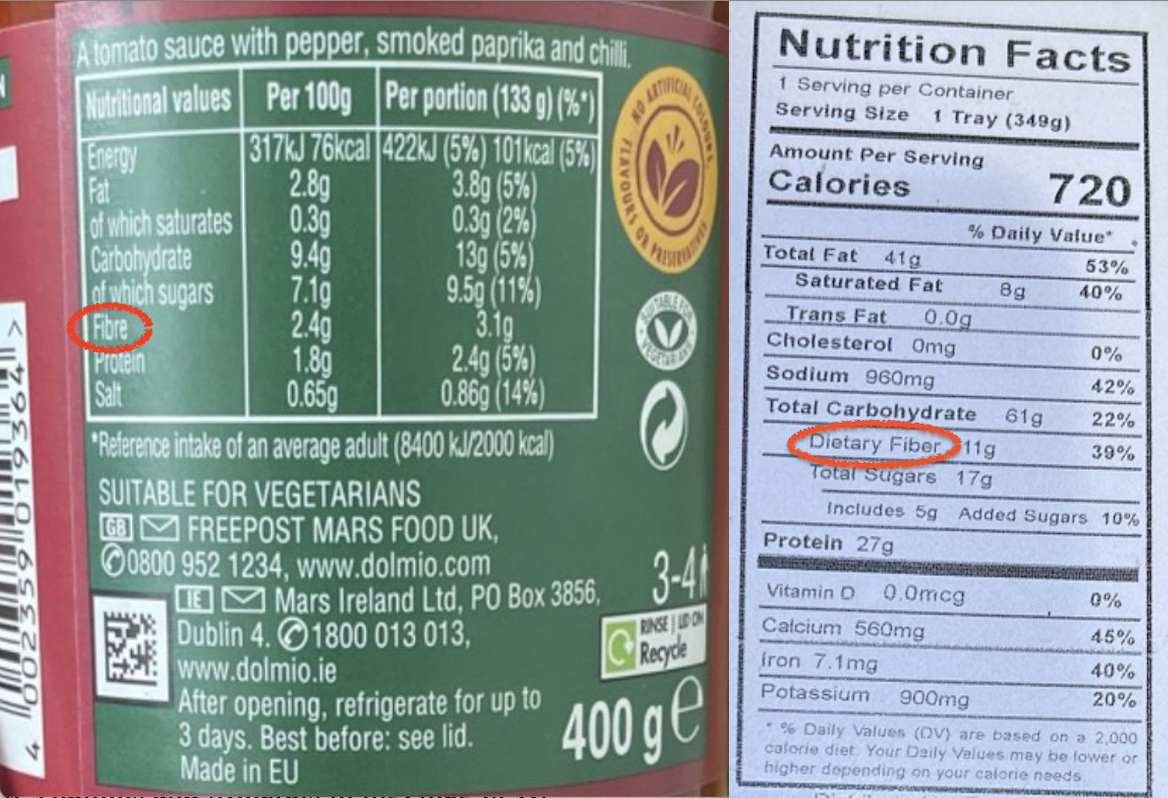
Illustration: US label compared to EU label.
For more details on the use of fiber vs. fibre, refer to this detailed article by Sapling.
2. Food Labels in the UK, AU, and EU
In the UK, Australia, and the European Union, food labels provide detailed information on energy (expressed in both kilojoules and kilocalories), macronutrients, and additional categories like fiber and salt. It's important to note that salt is often explicitly listed rather than sodium, which is commonly found in US labels.
3. Percent Daily Values (%DV)
One of the major differences between the regions is how they display percent daily values, or recommended intake values for nutrients. The US labels use %DV based on a 2,000-calorie diet, which helps individuals understand how a serving fits into their daily nutritional goals. On the other hand, the UK, AU, and EU food labels might use terms like "Reference Intake" or RDI.
4. Key Nutrient Labeling Differences to Be Aware Of
Users in the UK and other regions may notice that nutrition labels and nutrient names differ from what’s commonly used in the U.S. To make tracking easier and more accurate, it's helpful to understand these common differences:
- Sugars and Added Sugars: U.S. nutrition labels typically separate “Total Sugars” from “Added Sugars.” In contrast, many international labels (including those in the UK and EU) only show “Total Sugars,” without highlighting how much was added during processing.
- Sodium vs. Salt: While U.S. labels list “sodium,” labels in the UK, EU, and Australia often show “salt” instead. This can be confusing if you're used to tracking sodium. For reference, salt content is roughly 2.5 times the amount of sodium.
These differences can affect how nutrients appear in food entries, so it’s good to stay aware when comparing labels or logging foods from international products.
How to Switch Labeling Styles
To support users globally, the app automatically adjusts food label styles based on the country associated with your profile in Google Play or the App Store. Nutrient presentation is configured to match local labeling standards, with no manual setup required.
FAQ Section for Further Details
We are working to improve localization for UK, AU, and EU users. This includes changing labels like 'fiber' to 'fibre' and adapting nutrient categorization to align with local food labeling conventions.
Why are carbs different on my label? The difference often comes down to whether fiber is included in the total carbohydrates, depending on your labeling region.
How are energy values displayed? Energy is shown in kilojoules (kJ) and kilocalories (kcal) in UK, AU, and EU labels, whereas the US typically uses only kcal.
Why is salt listed instead of sodium? Salt provides a clearer understanding for individuals in Europe, while sodium is more prevalent on US labels.
Food labels can be confusing when standards vary across regions. Fortunately, the app automatically adjusts label formats based on your country settings, helping you view the most relevant nutritional data for accurate tracking. If you have any additional questions or suggestions, email us at support@mynetdiary.com. We're here to help you get the most out of your nutritional tracking and achieve your goals!